

We Were Promised: Past School Decisions Resurface as County Commission Debates New $47 Million Facilities Plan
Charlotte, TN — As Dickson County leaders begin weighing a proposed $47 million school facilities plan, an unexpected moment during the February 17, 2026 Dickson County Commission meeting revealed that the debate may not be about money alone.
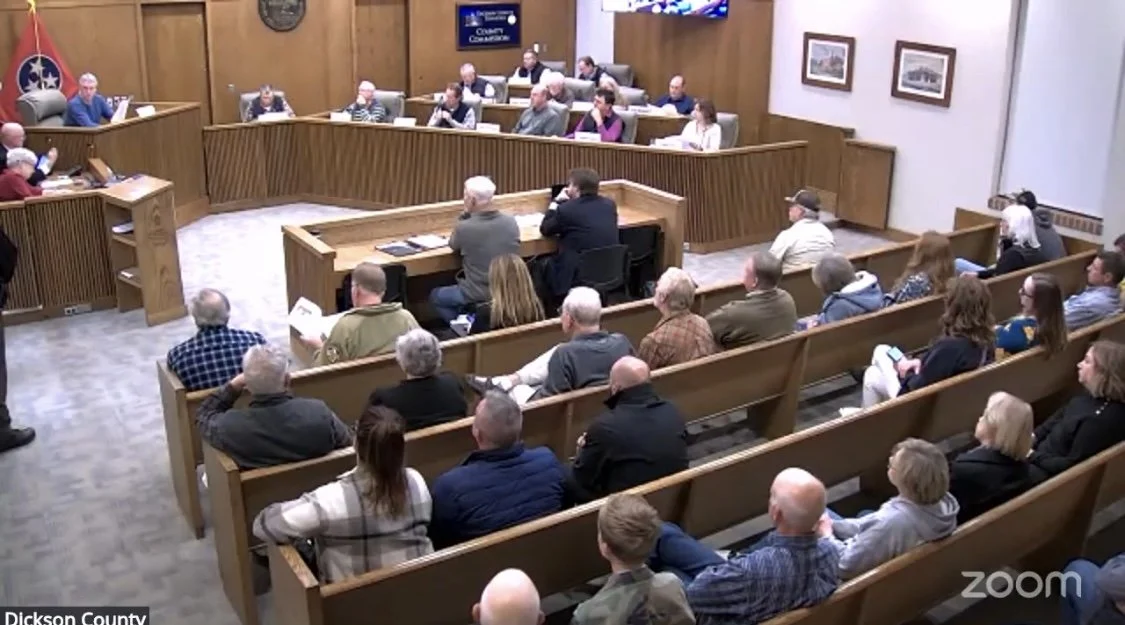
Photo: Dickson County Commission Meeting, Tuesday February 17th, 2026 (YouTube/Zoom)
It may also be about memory — and trust.
During a lengthy discussion following a presentation by Dickson County Schools requesting a partnership to fund major facility upgrades, one commissioner publicly voiced skepticism rooted not in the current proposal itself, but in decisions made years earlier when the county approved construction of Burns Middle School.
“I was promised that the kids on White Bluff Road would go to the new Burns School. Well, they’re not going to the Burns School,” the commissioner said, recalling the earlier vote. “I was the deciding vote on that.”
The comment shifted the tone of the discussion, highlighting lingering concerns among some county leaders about whether long-term school planning commitments ultimately unfold as originally presented.
A New Proposal — and Old Questions
Earlier in the meeting, Director of Schools Dr. Christie Southerland and School Board Chairman Sonya Brogdon presented commissioners with a resolution requesting approval to move forward with significant facility improvements across the district.
The proposal outlines up to $47 million in projects, including:
Classroom additions
HVAC system upgrades
Security improvements
Roofing replacements
Cafeteria expansions
Auditorium renovations
Demolition of the old Oakmont facility
Transportation and infrastructure upgrades
The funding model calls for $17 million from the school system’s fund balance combined with a requested $30 million commitment from county government, financed through debt service without a proposed tax increase.
County Mayor Bob Rial emphasized the county’s financial position, telling commissioners that years of debt management have placed Dickson County in a position to borrow responsibly.
“We can take on this debt without raising taxes,” Rial said, noting the county’s improved financial standing and growing tax base.
But for at least one commissioner, the question was not simply whether the county can borrow — but whether future outcomes will match present expectations.
The Burns Middle School Memory
During discussion, the commissioner referenced the earlier approval of Burns Middle School, describing himself as the deciding vote at the time and recalling assurances made during that process.
According to the commissioner, expectations about long-term planning did not ultimately unfold as anticipated.
He added that ongoing conversations about future school construction — including discussion of a potential middle school in White Bluff — have created confusion about the district’s long-range planning direction.
“It’s all confusing to me,” he said. “It’s like going downhill… there’s never no end to it.”
The remarks were not directed at current school leadership personally but reflected broader frustration about how evolving demographics and growth pressures can reshape plans long after votes are cast.
Growth Changes the Equation
School officials have consistently noted that enrollment growth, shifting population patterns, and facility conditions require plans to adapt over time.
Dr. Southerland framed the request as a partnership between schools and county government.
“Outcomes and funding go hand in hand,” she told commissioners. “We work together to better our community and students and families that believe in the public education system.”
Still, the commissioner’s comments illustrated a political reality facing local governments.
A Philosophical Difference
The exchange also revealed a deeper philosophical divide on the commission.
While county leadership emphasized strong credit capacity and historically low debt ratios, the commissioner questioned whether additional borrowing — even without raising taxes — is the right approach.
“If we’ve got that much extra money,” he asked, “why aren’t we putting it toward the debt?”
The concern reflects a common tension in local governance: balancing fiscal caution with infrastructure investment.
For supporters of the proposal, delaying projects risks higher construction costs later. For skeptics, borrowing today can feel like committing future leaders — and taxpayers — to decisions whose long-term impacts remain uncertain.
The commissioner’s remarks served as a reminder that past decisions remain part of the present conversation.
When governments ask voters and elected officials to commit tens of millions of dollars, history often becomes part of the debate.