

Six Candidates Lay Out Visions at Dickson County Mayor Forum
Dickson, TN — The race for Dickson County Mayor took center stage Monday night as six candidates gathered at the Dickson Fairgrounds Pageant Building for a public forum sponsored by 101.5 FM “The Ride” and moderated by Alex Denis.
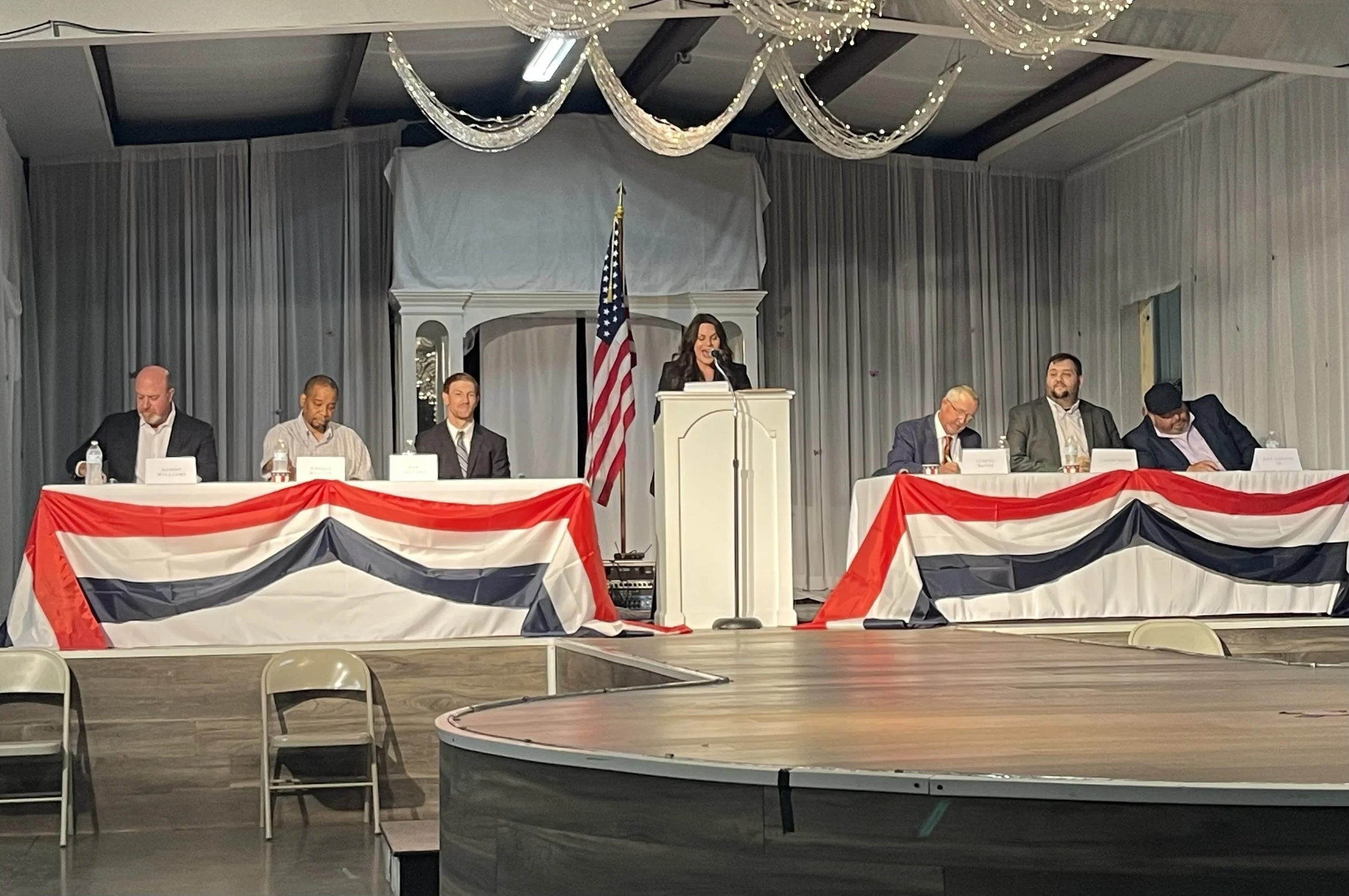
Photo: Dickson County Mayor Forum, Justin Spurlock
The event began promptly at 7:00 p.m. with a full crowd in attendance. The event offered voters an early opportunity to hear directly from the candidates about their backgrounds, motivations, and visions for the future of the county.
The forum opened with a foundational question posed to each candidate: why they are running for mayor and what vision do have for Dickson County moving forward?
Each candidate approached the question from a personal perspective, highlighting their connections to the community, professional experience, and priorities if elected.
Danny Williams emphasized his deep roots in Dickson County, noting that his family history in the area dates back to the early 1800s. Drawing on his experience in construction, infrastructure, and utilities, Williams pointed to his previous service as mayor of White Bluff and as a county commissioner as qualifications he believes prepare him to lead at the county level.
Reggie Weaver described himself as a longtime resident with a commitment to public service, including his work helping individuals struggling with addiction. Currently pursuing a doctoral degree, Weaver also reminded attendees that this is not his first campaign for the office, having run four years ago.
Ben Shepard highlighted both his local upbringing and professional experience, noting that he is a 2003 graduate of Dickson County High School and holds a master’s degree from Duke University. An engineer by trade, Shepard spoke about his focus on building a safe community while promoting transparency and maintaining the traditions that define Dickson County. He also referenced his family ties to education, noting that his wife is a school teacher.
Stacey Batey pointed to his lifelong connection to the community, having been born and raised in Dickson County and graduating from Dickson County High School in 1985 before attending UT Martin. With 16 years of experience as a county commissioner, Batey emphasized his long standing involvement in local government, as well as his background in business, including his work with Curvy Road Saw Mill. He also mentioned that he has two daughters who are teachers and work in the Dickson County School system.
Caleb Wray shared his story of moving to Dickson County and ultimately choosing to make it home. In addition to serving as a preacher at Rock Church of Christ, Wray outlined his involvement in community organizations, including his role as chair of the Dickson County Cancer Auction and treasurer of the Renaissance Players. He also noted his experience as a small business owner, operating a tax business in Charlotte.
Ray Ledger acknowledged that while he is not a lifelong resident, he has called Dickson County home since moving to the area in 1988. He spoke about building a successful HVAC business and emphasized his political independence, noting that he opposed efforts to make county races partisan. Ledger stated that while he considers himself a conservative, he is running as an independent and will not participate in a party primary.
Following the opening introductions, candidates were asked to address a key issue for the county’s future: how to attract business to Dickson County and what types of businesses leaders should prioritize.
Ben Shepard emphasized the importance of being selective, arguing that growth should be intentional rather than automatic. He said the county should focus on attracting businesses that provide meaningful jobs and support local families, rather than developments like large data centers that may offer limited long term community benefit. Shepard also stressed the need for local control in negotiations, pointing to past deals as examples where community benefits—such as financial contributions tied to projects—can be secured when leaders negotiate it.
Stacey Batey pointed to Dickson County’s existing strengths as a major selling point. He noted that infrastructure, schools, and other investments are already drawing people to the area. Batey specifically referenced projects like the construction of a new YMCA and the county’s school system, arguing that these amenities make the community attractive not only to residents, but also to businesses looking for a stable and growing workforce.
Caleb Wray echoed the idea of intentional growth, encouraging leaders to be purposeful in recruiting companies that align with the county’s values. He framed business development as an opportunity to build long term partnerships, saying the focus should be on attracting organizations willing to invest back into the community rather than simply operate within it.
Ray Ledger highlighted the role of small businesses as the foundation of the local economy. While acknowledging the importance of attracting larger employers, Ledger stressed that supporting existing small businesses must remain a priority. He described small businesses as deeply embedded in the community, often contributing to local schools and youth programs, and argued that economic development efforts should balance both recruitment and retention.
Danny Williams focused on two factors he believes businesses consistently evaluate when choosing a location: the strength of local schools and the vitality of the community’s traditional commercial areas. He said the two questions businesses typically ask when they are considering moving to the area: 1) Are the schools strong? And 2) is Main Street thriving? He said Dickson County must continue improving in both areas while also working to attract employers that provide jobs locally, reducing the need for residents to commute to Nashville or other surrounding areas for work.
Reggie Weaver centered his response on workforce development, stating that education is the driving force behind successful economic growth. He argued that attracting industry depends on having a well educated and qualified workforce, and emphasized the importance of investing in education to prepare residents for future job opportunities.
The discussion then shifted to infrastructure and county services, with candidates asked to identify the most urgent needs facing Dickson County and how those needs should be addressed and funded.
Stacey Batey pointed to traffic congestion as a growing concern across the county, noting that even smaller communities like Charlotte are beginning to feel the strain. He emphasized the importance of working closely with state officials and legislators to secure transportation solutions, warning that delays in planning and action could put the county further behind. In addition to roads, Batey highlighted the need for expanded sewer infrastructure to support future growth.
Caleb Wray identified multiple pressure points, including roads, schools, and solid waste, but focused particularly on the county’s landfill situation. He noted that Dickson County is currently shipping waste to another county and stressed the importance of developing a long term solution locally. Wray framed the issue as one that requires immediate attention to avoid larger challenges in the future.
Ray Ledger echoed many of the concerns raised by other candidates, emphasizing infrastructure and services as critical to the county’s continued growth. While aligning broadly with the issues discussed, he underscored the importance of addressing them in a way that reflects the county’s priorities and long-term sustainability.
Danny Williams focused on the county’s relationship with the state, particularly regarding transportation projects that have been discussed but not yet delivered. He referenced 840 and its potential extension to Burns, and argued that the next mayor must actively engage with state leaders to move those projects forward. On the issue of solid waste, Williams stated that current arrangements with Camden provide sufficient capacity for the near future, indicating that it is not an immediate concern.
That point prompted a direct but cordial exchange between candidates. Reggie Weaver responded by noting that his understanding differed, suggesting that the timeline for landfill capacity may be significantly shorter—closer to five years. After being mentioned, Williams was given an opportunity to respond and reiterated that his information came directly from discussions with waste management officials in Camden, maintaining that the longer timeline is accurate.
Ben Shepard, while acknowledging that many of the major concerns had already been raised, placed particular emphasis on wastewater infrastructure. He described sewer capacity as one of the most pressing long-term challenges facing the county, noting that previous expansion efforts into neighboring areas like northern Hickman County had not materialized. Shepard pointed to ongoing expansion at the Jones Creek facility but warned that additional planning and investment will be necessary to meet future demand.
Across the board, candidates agreed that infrastructure will play a defining role in Dickson County’s future, though they differed in how immediate certain challenges are and how best to prioritize solutions.
The forum then turned to education, with candidates asked to identify what they see as the biggest need facing Dickson County schools.
Caleb Wray framed the issue in terms of long term impact, emphasizing that today’s students will shape the future of the community as future “Dicksonians.” He said schools must be equipped with the resources necessary to succeed.
Ray Ledger echoed the importance of investing in students, describing them as the foundation of the county’s future. He emphasized the need to ensure that students have access to the tools, support, and opportunities required to be successful both inside and outside the classroom.
Danny Williams focused on collaboration between county government and the school system, stressing the importance of partnership with the Dickson County School Board. He highlighted the need for expanded programs to serve students with specialized needs, including those on the autism spectrum, as well as increased support for career and technical education programs that help students transition directly into the workforce.
Reggie Weaver, who noted that he currently drives a school bus, brought a firsthand perspective to the discussion. He suggested that county leaders should take a closer look at how education funding is allocated, raising concerns about administrative costs and encouraging a review of whether spending is too “top heavy” at the county level.
Ben Shepard approached the issue from a resource management standpoint, drawing on his background as an engineer. He emphasized finding efficiencies within the system to stretch available funding further, allowing for greater investment in student needs. Shepard also described schools as a central part of the community’s identity and raised concerns about declining enrollment, suggesting that efforts should be made to attract and retain students within the district.
Stacey Batey pointed to teacher retention and compensation as a primary concern. He said increasing teacher pay is critical to maintaining a strong school system and advocated for the return of “grow your own” initiatives aimed at developing future educators locally. Batey also emphasized the importance of expanding trade and vocational programs to better serve students pursuing career paths outside of traditional four year degrees.
The conversation later broadened to quality of life issues, where candidates were asked what defines a strong and thriving Dickson County.
Ray Ledger pointed to safety and education as foundational elements, saying residents need to feel secure in their community while also having access to strong schools. He added that Dickson County’s existing strengths continue to attract new residents.
Danny Williams echoed similar themes, emphasizing safety, security, and education, while also raising concerns about affordability—particularly for seniors who may be struggling to keep up with rising costs.
Reggie Weaver said that believes Dickson County is a safe place to live, expressing that sentiment directly to Sheriff Tim Eads who was in attendance. However, he also highlighted affordability as a growing concern and pointed to the importance of maintaining and expanding the county’s park system as part of overall quality of life.
Ben Shepard focused on family life and community experience, describing quality of life in terms of raising a family in Dickson County. He mentioned the importance of amenities such as live music, walkable neighborhoods, and outdoor activities, and said the county should continue supporting parks and preserving historic sites.
Stacey Batey highlighted the role of essential services, pointing to the importance of strong EMS, fire, and sheriff’s departments. He said maintaining these services is critical, while also acknowledging affordability as a key concern for families.
Caleb Wray approached the issue from a broader perspective, asking whether the county is truly meeting the needs of its residents. He emphasized that affordability alone is not enough, arguing that the right infrastructure must be in place to ensure people can live, work, and thrive in Dickson County without needing to leave.
One of the most interesting discussions of the night centered on sober living homes, an issue that has drawn increasing attention in the community. Candidates were asked how the county should address concerns related to these facilities.
Williams noted that federal and state laws currently limit what local governments can regulate, explaining that homes with multiple residents are protected under those laws. He said any meaningful change would require action at the state level.
Weaver acknowledged the complexity of the issue, saying that while many people support second chances for those in recovery, there must also be thoughtful consideration about where such homes are located. Like Williams, he emphasized the need for legislative changes at the state level.
Shepard agreed and also argued for increased regulation and said local leaders should apply pressure to state lawmakers to address concerns, suggesting measures such as distance requirements from schools.
Batey took a more direct stance, expressing concern about the placement of sober living homes in residential neighborhoods. He suggested that such facilities would be better suited in more centralized or campus style settings rather than dispersed throughout communities.
Wray acknowledged that sober living homes can serve a positive role but said the lack of regulation remains a concern. He emphasized that solutions may require both state and federal involvement.
Ledger noted that while some of these homes provide value, there is a need for greater oversight and transparency. Drawing from his own experience servicing several of these properties, he said it is important for the community to better understand how they operate.
As the forum neared its conclusion, candidates were asked what their first priority would be if elected mayor.
Weaver said he would begin by strengthening the relationship between county government and the school board.
Shepard similarly emphasized working closely with the school system, particularly on teacher retention and improving starting salaries.
Batey said he would focus on meeting with department heads and the county’s budget director to better understand operational needs.
Wray highlighted communication and civic engagement, noting that many residents are not fully aware of who represents them at the local level.
Ledger also pointed to the importance of meeting with department leaders and reviewing the county’s financial position.
Williams described the role of mayor as that of a chief executive officer, saying his priority would be ensuring that ongoing county projects are properly managed and on track.
During final remarks, candidates reflected on their campaigns and motivations for running.
Batey noted he entered the race early and encouraged voters to stay engaged throughout the election cycle.
Wray highlighted his background and experience, including his time working for Secretary of State Tre Hargett.
Ledger reiterated his decision to run as an independent despite identifying as a Republican.
Williams emphasized his experience and focus on fiscal responsibility, stating that he would approach the role with a conservative mindset on budgeting and management.
Weaver encouraged voters to look beyond partisan politics and take time to evaluate each candidate individually.
Shepard closed by emphasizing his personal connection to Dickson County and his commitment to the community, noting both his family ties and his understanding of the county’s challenges and opportunities.
As the forum concluded, voters were left with a clearer view of the candidates’ priorities, backgrounds, and approaches to leadership—setting the stage for a very exciting next few months as Dickson County prepares to choose its next mayor.